
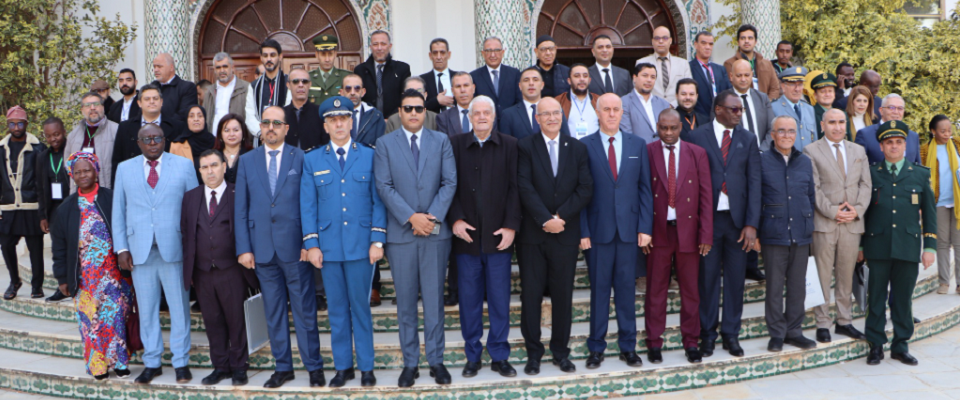


The second edition of the International Conference of the Pan African University (PAU) opened on Sunday, 1 December 2025, at the Pan African Institute of Water, Energy and Climate Change (PAUWES), for a duration of two days (1–2 December), under the theme:“Africa’s Path to Sustainability: Driving Change through Knowledge, Policy and Innovation.”
The opening ceremony took place in the presence of the Wali of the Wilaya of Tlemcen, Mr. Youcef BECHELAOUI, local authorities, Prof. Mourad MEGHACHOU, Rector of the University of Tlemcen, Prof. Jean KOULIDIATI, President of the Pan African University, Prof. Bolanle AKEREDOLU-ALE, Vice President of the Pan African University, as well as Prof. Abdellatif ZERGA, Director of the Pan African Institute of Water and Energy Sciences (including Climate Change) – PAUWES, Prof. Saido MADOGO, Director of the Higher Institute of Science and Technology of the African Union, and Dr. Gilles OGANDAGA.
This scientific gathering aims to reinforce the role of the Pan African University in promoting academic excellence, research and innovation across the continent. It also seeks to consolidate the principles of modern governance, promote African partnerships based on cooperation and knowledge exchange, and support scientific and cultural diplomacy.
From its outset, the conference highlighted the strategic challenges shaping Africa’s future: natural resource management, food security, climate resilience and energy transitions. The program is structured around three main scientific axes.
The first axis, entitled “Water, Sanitation and Climate Resilience,” drew considerable attention. On this occasion, Dr. Daphne GONDHALEKAR from the Technical University of Munich delivered a keynote address, shedding light on contemporary environmental issues and methodically emphasizing the interrelationship between climate variability and the sustainable management of water resources. Her presentation was followed by an extended oral session, providing a platform for in-depth scientific exchanges among experts and researchers.
The second axis, dedicated to “Renewable Energy, Infrastructure and Digital Transformation,” recorded a high attendance. The session opened with a presentation by Ms. Hassiba SAYAH, representative of the United Nations Industrial Development Organization (UNIDO), who discussed global dynamics toward clean energy and the mechanisms for integrating these transitions into sustainable development strategies. This was followed by a talk by Dr. Eric GANKAM TAMBO from the African Virtual University, addressing challenges related to digitization and innovation, as well as their implications for building future energy systems. Subsequent specialized oral sessions allowed for the exploration of prospects for developing energy infrastructures across the continent.
The third axis, entitled “Blue Economy, Agriculture and Food Security,” occupied a significant place in the day’s agenda due to its direct linkage to societal stability and well-being. Within this framework, Prof. Mokrani TOUHAMI from the University of South Africa delivered a major lecture on the development of GTL, BTL and PtX technologies, highlighting their strategic role in global energy transition pathways and their potential integration into sustainable models combining scientific innovation, environmental efficiency and economic performance.
The thematic communications and sessions provided a space to address contemporary challenges related to climate change, technological innovation and sustainable development. Exchanges between researchers, experts and African institutions revealed promising prospects for scientific and academic cooperation.
The conference also reflects the central role of Algeria as a key actor in university and scientific development at the continental level, particularly in the fields of renewable energy and water management, contributing to sustainability and the strengthening of national and African economies.
The first day concluded with a positive dynamic of exchanges and partnerships, paving the way for new avenues of collaboration in service of a more resilient and sustainable Africa.
 |
 |
 |
 |
 |
 |
 |
 |
 |
 |
 |
|
 |
 |
 |
 |
 |
 |